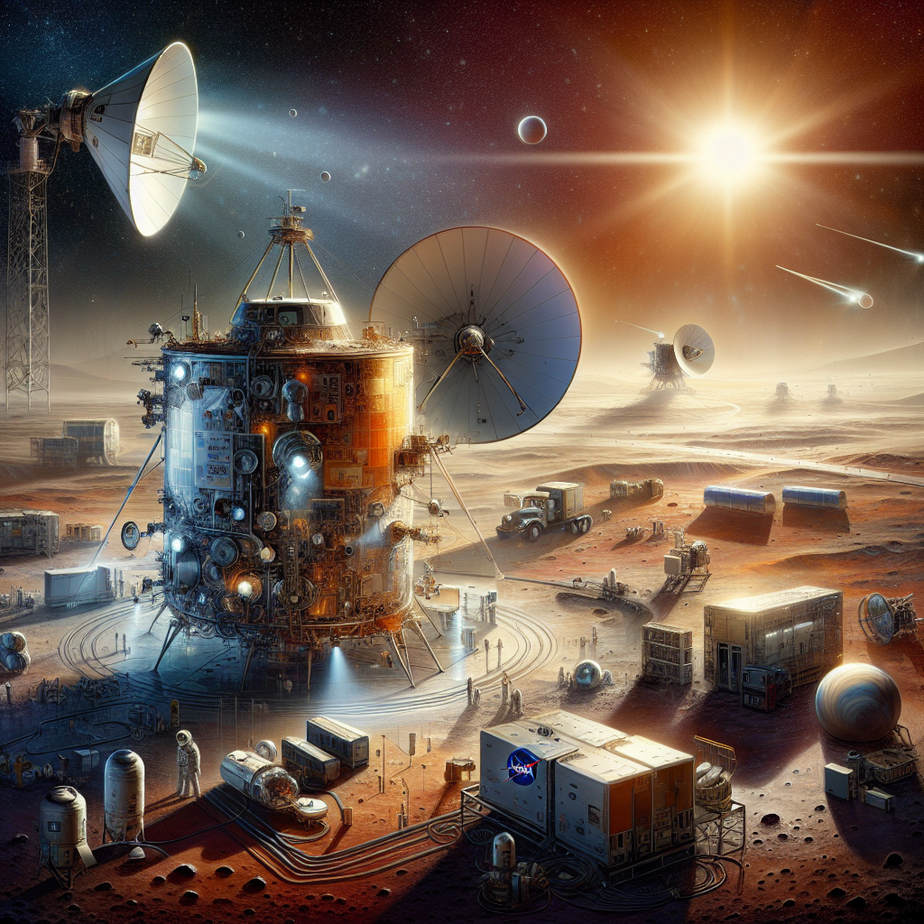
Fifty years ago, NASA embarked on one of its most ambitious quests: the Viking missions. These twin spacecraft had the monumental task of seeking out the mysteries of Mars, with a particular focus on the possibility of life. Their journey through space led to a groundbreaking moment in 1976 when they became the first successful missions to land intact and perform experiments on another planet. Decades later, the legacy of the Viking missions endures through the data they collected and the scientific debates they inspired.
The Viking missions were technological marvels of their time, each consisting of an orbiter and a lander. The landers were fitted with experimental chambers that conducted biology experiments, showcasing humanity’s first earnest attempt to uncover signs of life beyond Earth. These experiments, designed to detect biological activity, produced results that were both tantalizing and puzzling. Some suggested the potential for life, but without conclusive evidence, they left researchers with more questions than answers.
One of the most fascinating aspects of the Viking missions is how they have spurred ongoing discussions and research into the presence of life on Mars. The experiments conducted on Mars, while groundbreaking, were limited by the technology available at the time. Despite this, the mission’s findings continue to be a touchstone for astrobiologists and planetary scientists. They have inspired new methodologies and more sophisticated instruments on recent missions, setting a foundation upon which the current Mars exploration efforts are built.
The pursuit of life on Mars remains a compelling driver of space exploration. The Viking missions, with their inconclusive results, highlighted the complexity and difficulty of the search for extraterrestrial life. Nonetheless, they proved to be a catalyst for future missions which have continuously pushed the boundaries of space technology, particularly in how life-detection experiments are designed and executed. The drive to fully understand these findings remains as vibrant as the red planet itself.
Reflecting on the Viking missions and their enduring influence, we see a larger narrative. It’s a testament to humanity’s unyielding curiosity and determination to answer one of the most profound questions: Are we alone in the universe? Though the Vikings did not provide a definitive answer, they opened doors to inquiry and innovation that continue to propel us forward in our cosmic quest. As technology advances, we edge ever closer to potentially answering that age-old question, discovering what truly lies beneath the Martian surface.